
1790–1876
The Roots of Immigration Control
The Origins of U.S. Immigration Control
Before the Civil War, the power to regulate migration rested primarily with state and local authorities because Southern slavers worried that federal control over migration matters might impede the transatlantic slave trade, interrupt the domestic slave trade, and dampen the enforcement of fugitive slave laws. The Constitution protected their interests by delegating to Congress the power to “establish a uniform Rule of Naturalization,” but otherwise banning Congress from regulating “the Migration or Importation of such Persons as any of the States now existing shall think proper to admit” before 1808. With the exception of the little-utilized “Alien Friends” and “Alien Enemies” Acts of 1798, and an 1803 law adopted to reinforce state laws banning free Black migration to the United States, it would not be until the Civil War, which ended slavery and generally expanded the reach of the federal government, that Congress and the executive branch seized their now-familiar authority over immigration matters.
Still, early efforts by state and local governments to regulate the right to independently remain within or freely enter territories claimed by U.S. settlers served as a laboratory for the modern immigration regime. State and local authorities banned the entry of free Black people and expelled sovereign Indigenous nations, typically with federal backing. For example, presidents repeatedly dispatched federal troops to brutally dispossess Indigenous nations of their lands, while Congress backed a series of state laws that denied entry to free Black migrants and targeted those who arrived for mandatory detention and enslavement. Meanwhile, four congressional “firsts” firmly articulated the priorities of the nation’s nascent immigration regime.

Text of An Act to Establish a Uniform Rule of Naturalization (1790) | Library of Congress
The Republic's First Naturalization Law
In 1790, Congress granted the right to naturalize to “any alien, being a free white person, who shall have resided within the limits and under the jurisdiction of the United States for the term of two years . . . .” The term “white” strictly limited naturalization to European immigrants. After residing in the United States for two years, any European could go to any courthouse to file a Petition for Naturalization, after which they would be “considered as a citizen of the United States.” Black people were not permitted to naturalize until after the Civil War, and many Asians remained prohibited from naturalizing until 1952. Meanwhile, in 1924 Congress imposed U.S. citizenship on all Indigenous people, in violation of Indigenous sovereignty.

Toussaint Louverture, a leader of the Haitian Revolution | Wikipedia Commons
The Republic's First Refugee Program
In 1791, Congress authorized the President to provide up to $10,000 of federal monies in cash assistance to resettle thousands of people fleeing the Haitian Revolution (1791–1804), which after expelling the colony’s enslavers, resulted in the establishment of the world’s first Black republic. This was the first federal allocation of cash assistance to a “refugee” community: it provided sanctuary and support to enslavers fleeing an event historians now describe as “the largest slave revolt in the history of the world, and the only one that succeeded.” Humanitarian protection laws remain a central feature of U.S. immigration policy, often serving as key components of larger racial and political projects. On January 20, 2025, President Donald J. Trump suspended all refugee admissions into the United States. On February 7, 2025, President Trump made an exception to this suspension by offering refugee status to Afrikaners, the white descendants of apartheid in South Africa.

Instructions to All Persons of Japanese Ancestry (April 1, 1942) | Library of Congress
A photo provided by El Salvador’s presidential press office of a prison guard transferring deportees from the U.S., alleged to be Venezuelan gang members, to the Terrorism Confinement Center (CECOT) in Tecoluca, El Salvador (Sunday, March 16, 2025) | AP
The Republic's First Deportation Laws
In 1798, still fearful that uncontrolled migration might spread the radicalism of the French and Haitian revolutions to the United States, Congress passed the nation’s first federal deportation laws: the 1798 Alien Friends Act and the 1798 Alien Enemies Act. The Alien Friends Act authorized the president to summarily deport any non-citizen he believed to be “dangerous to the peace and safety of the United States, or shall have reasonable grounds to suspect are concerned in any treasonable or secret machinations against the government.” It was an unpopular law which lapsed after two years and was never renewed. In contrast, the Alien Enemies Act, which authorized the president to “apprehend, restrain, secure, and remove” people from a “hostile” nation who are 14 years or older whenever the U.S. is at war, or under “any invasion or predatory incursion,” was used extensively in World War I and II, and remains law to this day. Most notoriously, President Franklin D. Roosevelt used the 1798 law to broadly imprison Japanese immigrants living on the West Coast and issued a separate Executive Order that authorized the mass incarceration of American citizens of Japanese descent. On March 15, 2025, President Donald J. Trump invoked the 1798 law to deport Venezuelan migrants from the United States.

Immigrants being detained at Angel Island Immigration Station, California (1910s) | National Library of Medicine Digital Collections
An African American sailor (1860s) | Library of Congress
The Republic's First Immigration Bans
In 1803, a year before formerly enslaved people in the French colony of Saint Domingue declared Haiti to be a free Black republic, Congress prohibited ship captains from bringing any “negro, mulatto, or other person of color” into any state where a state law prohibited their entry. This law targeted free Black migrants, namely Haitians, whom Southern slavers feared might sail to the United States to ignite an armed revolt among the enslaved population across the U.S. South. By the 1830s, South Carolina, Florida, Georgia, North Carolina, Alabama, Louisiana, and Mississippi had passed a set of laws known as the “Negro Seamen Acts,” which prohibited ship captains from bringing Black migrants into their ports. According to these laws, when Black sailors and ship workers arrived in Southern ports, local sheriffs detained them in jail and charged their ship captains a fee for detaining their passengers. If ship captains did not pay the fee, sheriffs were authorized to sell the detainees into slavery. By the time of the Civil War, Southern authorities had used the Negro Seamen Acts to arrest up to 20,000 free Black migrants, incarcerating most of them and selling an untold number into slavery.
Text of An Act to Establish a Uniform Rule of Naturalization (1790)
First, in 1790 Congress extended[d] the right to naturalize to “any alien, being a free white person, who shall have resided within the limits and under the jurisdiction of the United States for the term of two years…”2 The term “white” strictly limited naturalization to European immigrants. After residing in the United States for two years any European could go to any courthouse to file a Petition for Naturalization, after which they would be “considered as a citizen of the United States.”3 Black people were not permitted to naturalize until after the Civil War, while, in 1924, Congress imposed U.S. citizenship on all Indigenous persons (a violation of Indigenous sovereignty) and categorically prohibited all Asian immigrants from naturalizing. Congress would not abolish all racial bars on naturalization until 1952.4
Second, in 1791, Congress authorized[e] the President to provide up to $10,000 of federal monies in cash assistance to resettle thousands of people fleeing the Haitian Revolution (1791 – 1804), which after expelling the colony’s enslavers, resulted in the establishment of the world’s first Black republic.5 This was the first federal allocation of cash assistance to a “refugee” community: it provided sanctuary and support to enslavers fleeing an event historians now describe as “the largest slave revolt in the history of the world, and the only one that succeeded.”6 Humanitarian protection laws remain a central feature of U.S. immigration policy, often serving as key components of larger racial and political projects. On January 20, 2025, President Donald J. Trump suspended all refugee admissions into the United States.7 On February 7, 2025, President Trump made an exception to this suspension by offering refugee status to Afrikaners, the white descendants of apartheid in South Africa.8
Third, in 1798, still fearful that uncontrolled migration might spread the radicalism of the French and Haitian revolutions, Congress passed the nation’s first federal deportation laws: the 1798 Alien Friends Act and the 1798 Alien Enemies Act. The Alien Friends Act authorized the president to summarily deport any non-citizen he believed to be “dangerous to the peace and safety of the United States, or shall have reasonable grounds to suspect are concerned in any treasonable or secret machinations against the government.”9 It was an unpopular law, which lapsed after two years and was never renewed.10 In contrast, the Alien Enemies Act, which authorized the president to “apprehend, restrain, secure, and remove” persons from a “hostile” nation who are 14 years or older whenever the U.S. is at war, or under “any invasion or predatory incursion,” was used extensively in World War I and II, and remains law to this day.11 Most notoriously, President Franklin D. Roosevelt used the 1798 law to broadly imprison Japanese immigrants living on the West Coast and issued a separate Executive Order that authorized the mass incarceration of American citizens of Japanese descent. On March 15, 2025, President Donald J. Trump invoked the 1798 law to deport Venezuelan migrants from the United States.
Fourth, in 1803, a year before formerly enslaved persons in the French colony of Saint Domingue declared Haiti to be a free Black republic, Congress prohibited[g] ship captains from bringing any “negro, mulatto, or other person of color” into any state where a state law prohibited their entry.12 This law targeted free Black migrants, namely Haitians, whom southern slavers feared might sail to the United States to ignite an armed revolt among the enslaved population across the U.S. South. By the 1830s, South Carolina, Florida, Georgia, North Carolina, Alabama, Louisiana, and Mississippi had passed a set of laws known as the “Negro Seamen Acts,” which prohibited ship captains from bringing Black migrants into their ports.13 According to these laws, when Black sailors and ship workers arrived in southern ports, local sheriffs detained them in jail and charged their ship captains a fee for detaining their passengers. If ship captains did not pay the fee, sheriffs were authorized to sell the detainees into slavery. By the time of the Civil War, Southern authorities had used the Negro Seamen Acts to arrest up to 20,000 free Black migrants, incarcerating most of them and selling an untold number into slavery.14
Creating the "White Man's Republic"
After the Civil War, Congress and the Executive Branch replaced states and municipalities as the primary architects of immigration control. In 1875, the Supreme Court rejected California’s attempt to summarily fine and exclude Chinese women, ruling that the federal government had “exclusive” authority to control the admission of people from abroad. Ever since, federal authorities, led by Congress and the Executive Branch, have set the course of U.S. immigration control.
But these federal actors would not entirely reinvent the system. They modeled many of their strategies on the state and local efforts that had already tested everything from entry bans and mandatory detention to criminalization and mass deportation—strategies that had already been adopted to make migration control a tool of racial exclusion and subordination in a white settler republic.
In Their Own Words
“Our ancestors…proceeded forthwith to drive out the aborigines from the land with fire and sword, and to occupy it for themselves and their posterity…it is of the gravest importance to future peace and well being of this country to that we do not voluntarily create other relations with colored foreign peoples.”
Senator La Fayette Grover (D-OR), 1882
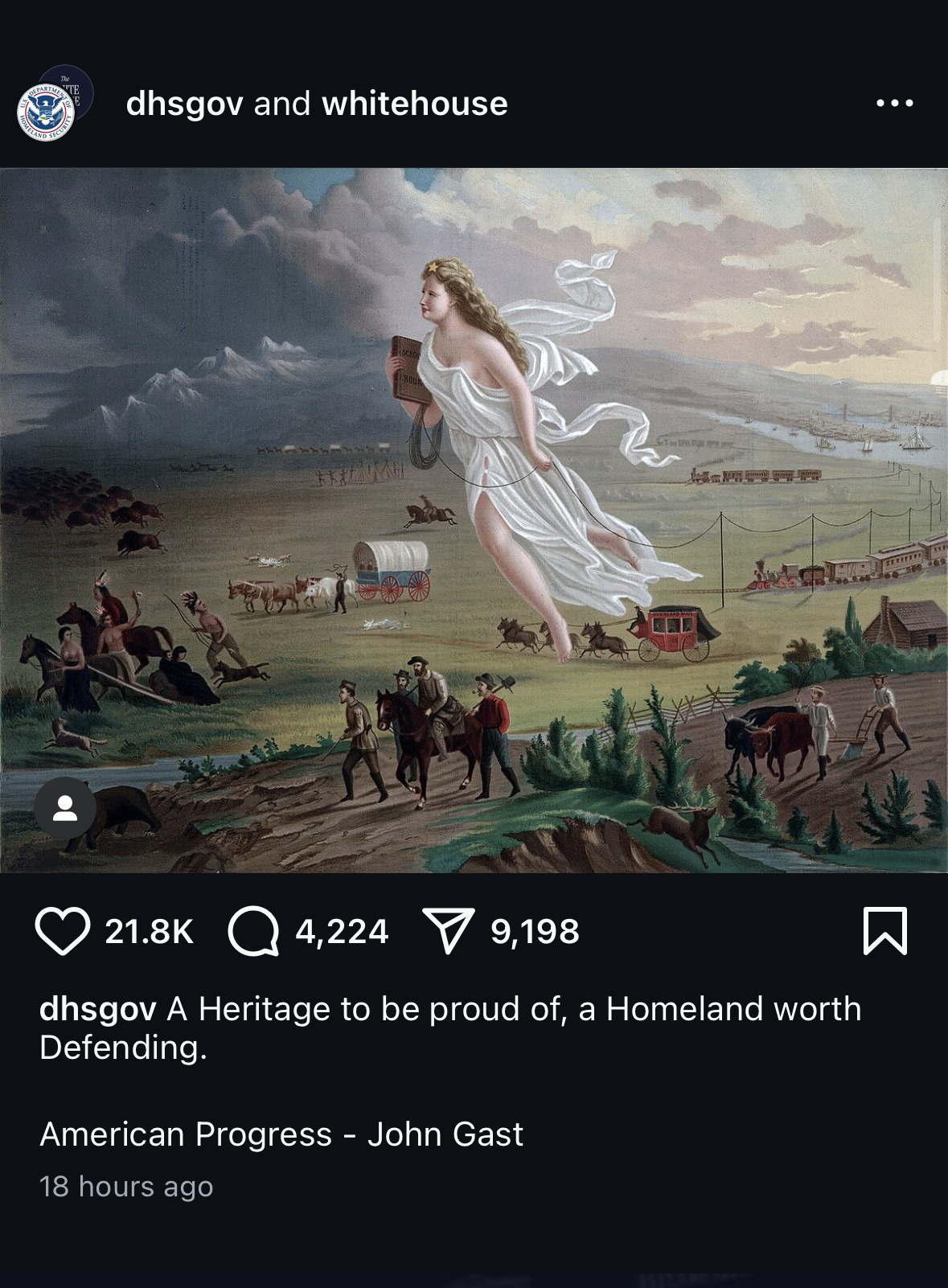
Fast Forward to Now
Screenshot of an Instagram post from the Department of Homeland Security (@dhsgov) and White House (@whitehouse) on July 23, 2025 with the caption "A Heritage to be proud of, a Homeland worth Defending. American Progress - John Gast"
Timeline of Key Events
Naturalization Act of March 4, 1790

The nation’s first naturalization law, the 1790 Naturalization Act restricted the right to naturalize to “any alien, being a free white person, who shall have resided within the limits and under the jurisdiction of the United States for the term of two years . . . .” The term “white” strictly limited naturalization to European immigrants. Congress would not abolish all racial restrictions on naturalization until 1952.
The Haitian Revolution (1791 - 1804)
On August 22, 1791, enslaved people on the French-controlled island of Saint Domingue, the most profitable colony in the world, launched a mass rebellion. By 1804, the freedom fighters had ousted the French from Saint Domingue and established Haiti, the first Black republic in the Americas. This event inspired the nation’s first immigration ban as well as the nation’s first refugee allocation.
“An act providing for the relief of such of the inhabitants of Santo Domingo, resident within the United States, as may be found in want of support” (January 28, 1794)
Amid the Haitian Revolution (1791-1804), whites, especially slaveholders, fled the island en masse. In 1794, Congress authorized the President to provide the thousands of French refugees arriving from Haiti (then Saint Domingue) with cash assistance to resettle in the United States. This was the nation’s first federal allocation of refugee aid in the United States.
The Alien Friends and Alien Enemies Acts of 1798
Amid the French and Haitian revolutions as well as domestic political struggles between the Federalists (George Washington, John Adams, and Alexander Hamilton, who were pro-British and advocating for strong central government) and the Democratic-Republicans (Thomas Jefferson and James Madison, who were pro-French and advocating for more state power), a federalist-dominated Congress passed the nation’s first federal deportation laws: the 1798 Alien Friends Act and the 1798 Alien Enemies Act. The goal was to limit French, pro-French, and French revolutionary influences, including the Haitian Revolution, on U.S. governance. The Alien Friends Act authorized the president to summarily deport any non-citizen he believed to be “dangerous to the peace and safety of the United States, or . . . concerned in any treasonable or secret machinations against the government.” It was an unpopular law, and never actually utilized. James Madison said the Alien Friends Act would “transform the present republican system of the United States, into an absolute, or at best mixed monarchy.” When Thomas Jefferson became president in 1800, he and a new Congress let the Alien Friends Act lapse and it was never renewed. In contrast, the Alien Enemies Act, which authorized the president to “apprehend, restrain, secure, and remove” people from a “hostile” nation who are 14 years or older whenever the U.S. is at war or under “any invasion or predatory incursion,” was used extensively in the War of 1812 as well as World War I and II.
Fast Forward to Now
March 15, 2025
The Alien Enemies Act remains law to this day. President Donald J. Trump invoked it on March 15, 2025, and used it to imprison and deport people without due process to a prison in El Salvador. Legal challenges to its use remain on-going.
Act of February 28, 1803
The Haitian Revolution (1791-1804) triggered mass panic among enslavers in the United States. Would Haiti’s Black freedom fighters inspire or ignite a similar revolt among enslaved people in the United States? Hoping to thwart any such revolt, Southern states banned free Blacks, especially from the Caribbean, from entering their states. For example, South Carolina banned “negroes from the West Indies,” Pennsylvania banned entry to “French Negroes,” and Georgia banned entry to all “free negroes” and enslaved Blacks from the West Indies. In 1803, Congress backed these state laws by passing the nation’s first immigration ban. It stated “no master or captain of any ship or vessel, or any other person, shall import or bring, or cause to be imported or brought, any [free] negro, mulatto, or other person of colour [into any state prohibiting their entry].” This was the nation’s first federal immigration ban.
1807 Act Prohibiting the Importation of Slaves (March 2, 1807)
This Act banned the importation of enslaved people into the United States, effective January 1, 1808. It was not an immigration law but the development of U.S. immigration control unfolded against the backdrop of slavery. Even after the importation ban, Southern slavers refused to allow the federal government to develop a national immigration regime, fearing that abolitionists would seize that power.
For a visualization of the trans-Atlantic slave trade across time see: The Atlantic Slave Trade in Two Minutes.
The Negro Seaman Acts (1822 - 1861)
Indian Removal Act (May 28, 1830)
The development of U.S. immigration control unfolded against the backdrop of the removal of Indigenous nations and the settler occupation of the region now claimed as the U.S. national territory. The Indian Removal Act of 1830 authorized the president to grant lands west of the Mississippi River to tribes who, under extraordinary pressure, left their homelands. It is but one example of how the federal government pursued the mass removal of Indigenous nations across the North American continent. President Andrew Jackson’s administration used the Act to forcibly remove an estimated 100,000 Indigenous nations from their homelands in what is now the states of Georgia and Alabama.
For a visualization of how the United States seized over 1.5 billion acres from America’s Indigenous people see: Invasion of America.
An Act to Prohibit the “Coolie Trade” by American Citizens in American Vessels (February 19, 1862)
During the U.S. Civil War, some Southern enslavers attempted to replace enslaved Black laborers with contract workers from China and India, whom many referred to as “coolie” labor. To prevent the rise of a new form of unfree labor in the U.S. South, Congress passed the “Anti-Coolie” Act, to “prohibit the coolie trade by American citizens in American vessels.”
The Fourteenth Amendment (July 9, 1868)

In the wake of the Civil War, Congress enacted and the States ratified a constitutional amendment that guaranteed citizenship to “all persons born or naturalized in the United States, and subject to the jurisdiction thereof,” regardless of race, and established that no state could deny “any person” equal protection or due process. Congress inserted the “subject to the jurisdiction thereof” into the birthright citizenship clause to exclude from birthright citizenship the children born to foreign diplomats, the children born to the soldiers of an occupying army, and Indigenous people subject to the authority of their tribal government.
Resistance Story
1869 - The Composite Nation
Frederick Douglass, an abolitionist and racial justice advocate, was one of the first public figures to speak out against Chinese exclusion. In a speech entitled, “The Composite Nation,” he warned that laws denying Chinese immigrants the right to enter the United States and prohibiting them from naturalizing as U.S. citizens jeopardized the experiment in “absolute equality” yet to be realized in the United States. “If the white race may exclude all other races from this continent, it may rightfully do the same in respect to all other lands, islands, capes, and continents, and have all the world to itself,” he warned.
Naturalization Act of 1870
Expanded the right to naturalize to include “aliens being free white persons, and to aliens of African nativity and to persons of African descent.” Senator Charles Sumner (R-MA), an abolitionist and long-time advocate of racial equality, attempted to pass a more sweeping version of the law, proposing an amendment to strike the word “white” from the naturalization act and all other federal laws. The Senate rejected the Sumner amendment. Congress did not abolish all racial restrictions in the nation’s naturalization system until 1952.
Page Act (Act of March 3, 1875)
Prohibited the arrival of “coolie” laborers and immigrants previously convicted of “felonious crimes.” It also criminalized the “importation” of “any subject of China, Japan, or any Oriental country” for “lewd and immoral purposes.” Federal authorities largely used this law to stop Chinese women from entering the United States.